3.2.1 Greeks Tool
3.2.1.1 Greeks Tool Overview
This page provides a compact EOD snapshot of the entire options chain for a given ticker over time, showing key position sensitive features and estimates of the impact of the options chain on the value of the underlying stock. Although it is impossible to determine the positions of hundreds of thousands of market participants in the options market, on the other side of those transactions are a handful of market makers who make money on the bid/ask spread of an options quote. In order to minimize their exposure to assignment risk on the options traded with participants, they must buy and sell the underlying stock. This market maker hedging is the mechanism by which trading options move markets (For more insight into the size of the options market see 2.1 The Tail Wags the Dog).
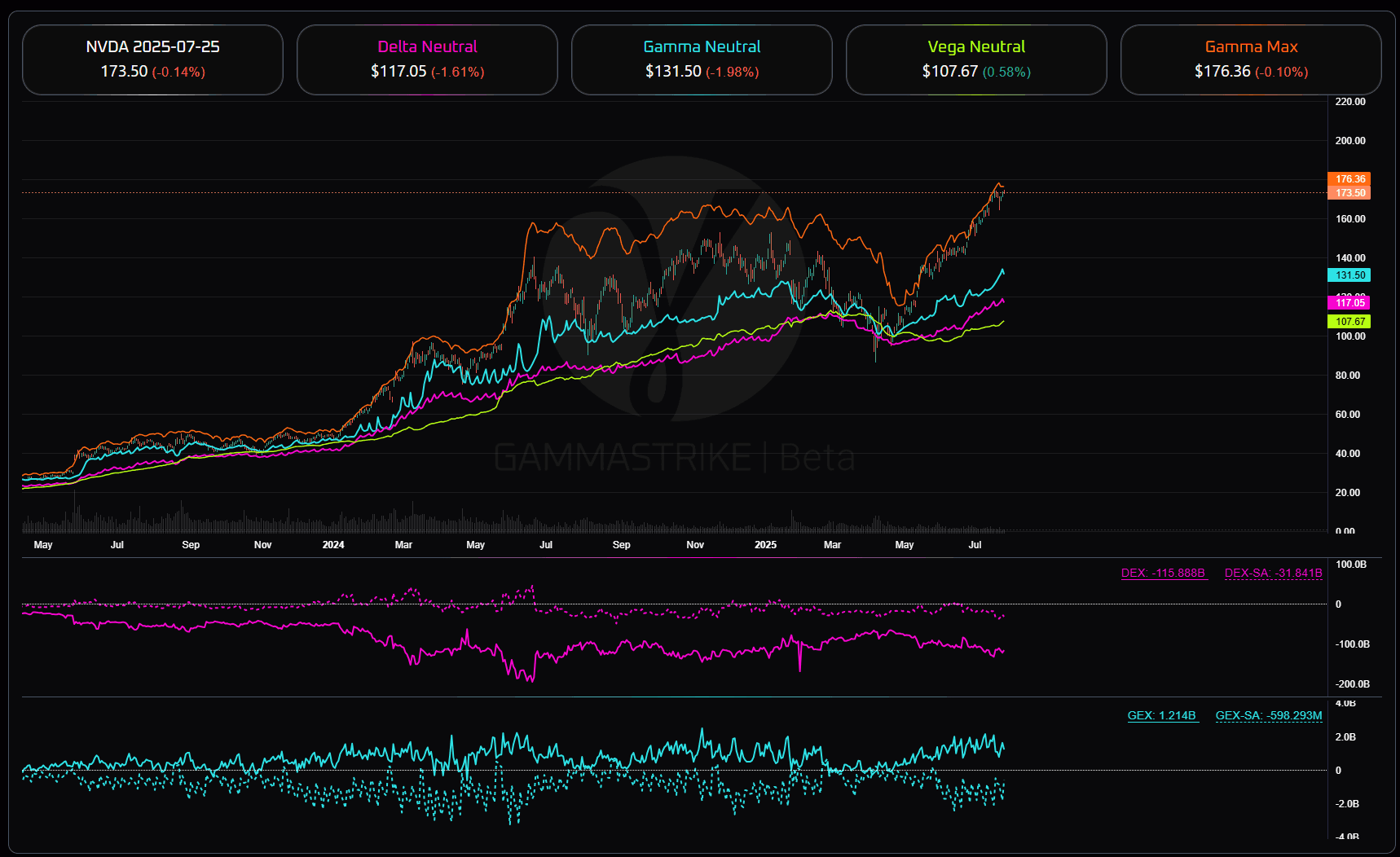
3.2.1.2 Greek Neutrals
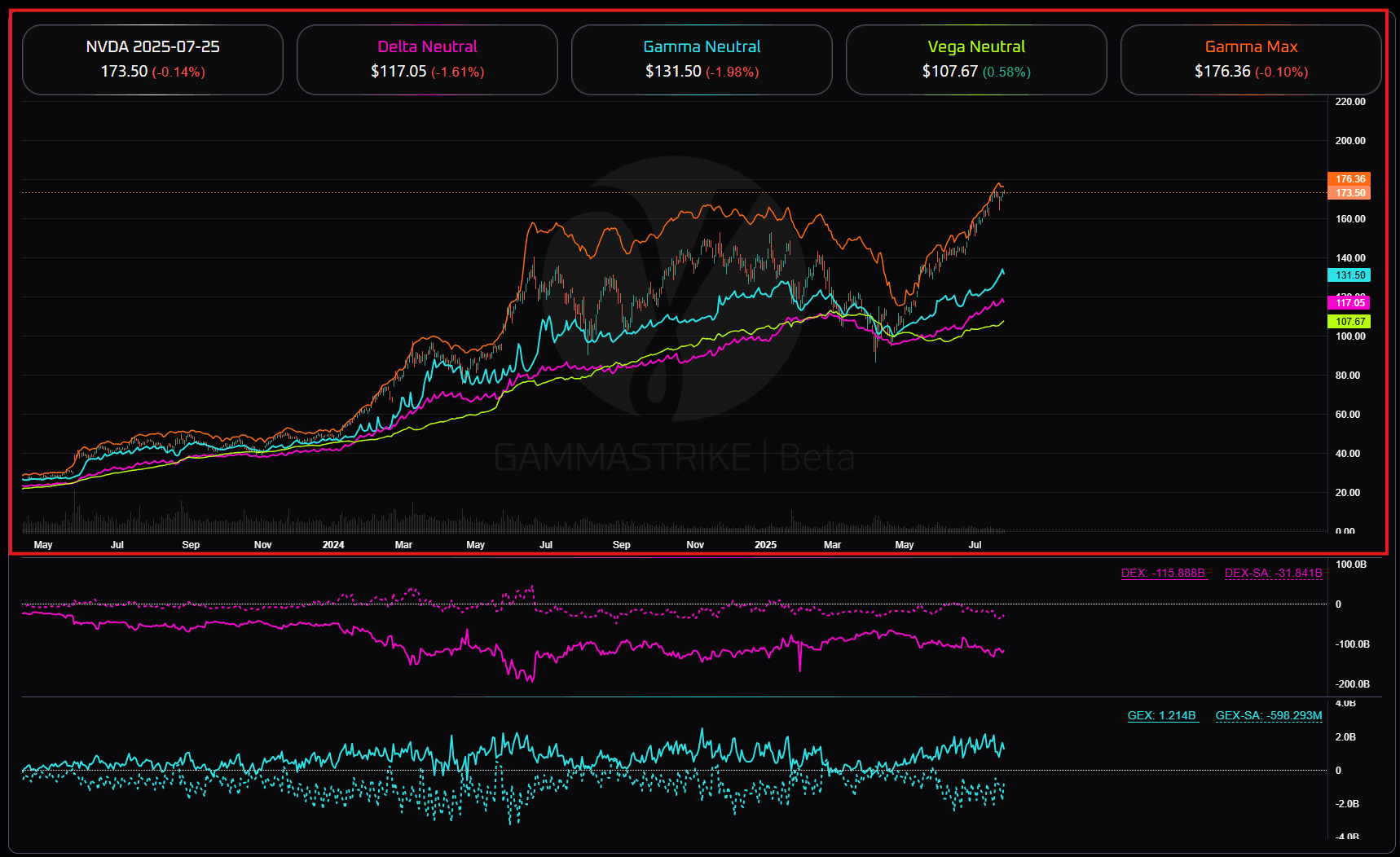
While the hedging strategies depend on an entire option chain, there are certain price levels that denote key aspects of that hedging environment, which we calculate and display each day. These levels are called Delta Neutral (DN), Gamma Neutral (GN), Gamma Max (GM), and Vega Neutral (VN), named after the specific features of an option contract known as greeks. These levels can provide insight into key levels of support and resistance for price in the market, and can identify regions of low or high volatility. See Sections 1-2 for a holistic overview of what these levels represent, and how they impact market trading.
3.2.1.3 Delta Neutral
As explained in previous sections 1-2, delta is a measure of how long or short the market makers must be on the underlying stock to reduce assignment risk for the contracts on their books. This aggregate delta exposure will vary based on changes in spot price. Typically, most open options contracts are out of the money, and so above spot is mostly calls, and below spot is mostly puts. Delta neutral represents the spot price at which the delta on calls and puts are equal. When the spot price is above DN, this means that calls have more impact on the delta environment. When spot is below DN, puts have more delta. This makes DN a natural anchor point, as most market participants are positioned on either side of this value. For this reason, large deviations from DN tend to revert over time. If we use the analogy of a swing on a swing set, DN is the lowest point on the arc path, and deviations from that point are resisted by gravity on either side.
The evolution of DN over time also provides insights into how traders are modifying their positions based on changes in spot. For example, if DN declines over time, This implies that either participants are reducing their delta exposure below DN or increasing their delta exposure above DN. This counterintuitive behavior shows that when DN declines, market participants expect spot to increase at a later time and are positioning for it. Conversely when DN is rising, it shows that participants are betting on a future reversion of spot back to DN.
3.2.1.4 Gamma Neutral
The delta of all options contracts changes with changes in spot, measured by gamma. Negative gamma means the market makers must buy when prices rise, and sell when prices fall, amplifying any moves in the market. For this reason, negative gamma tends to coincide with higher realized volatility. Conversely, positive gamma means the market maker sells into rising price and buys into falling price, meaning it dampens spot movement and lowers volatility. Gamma Neutral is the threshold at which the market crosses from negative (below) to positive (above). Often times market participants that want spot to continue to march upwards will strategically buy when the price is close to Gamma Neutral to prevent the underlying from gaining increased volatility. Slipping under GN generally results in some level of capitulation by long positions, as they rush to prevent large losses due to the imminent increase in realized volatility.
3.2.1.5 Vega Neutral
All contract prices are also sensitive to changes in the expected future volatility, or implied volatility (IV). As with the other neutrals, Vega Neutral is the point at which market makers have equal amounts of volatility exposure to both puts and calls, and changes to IV have little impact on market maker positioning. Generally, spot approaches VN when the dominant driver of underlying price is the buying or selling of large amounts of deep out of the money options, and VN is the point at which this strategy loses the ability to drive price action further. For example, a prolific strategy is to sell deep out of the money put options on the SPX, which collapses the IV smile below spot. This volatility crush has the overall effect of increasing market maker buying pressure, until the spot price reaches VN, at which point further selling of those deep OTM put contracts fails to push price further. In this situation, spot price slowly grinds up into VN and then quickly drops as those sold puts are ineffective and collapse on themselves. This process repeats until this put strategy is abandoned.
3.2.1.6 Gamma Max
Gamma max represents the spot price at which market makers must hedge the most possible gamma on the chain. Since the market maker is selling as spot climbs towards GM, it typically requires a very aggressive buying spree to reach this point. It also represents the spot price at which open interest on the chain starts to fall off. For these reasons, GM often acts as a local high for violent upward spot movement. However, if market participants are extremely aggressive, they can continue to lever up at higher spot prices as spot climbs, moving GM with it for some time before eventually profit taking collapses the surge.
3.2.1.7 Delta Exposure
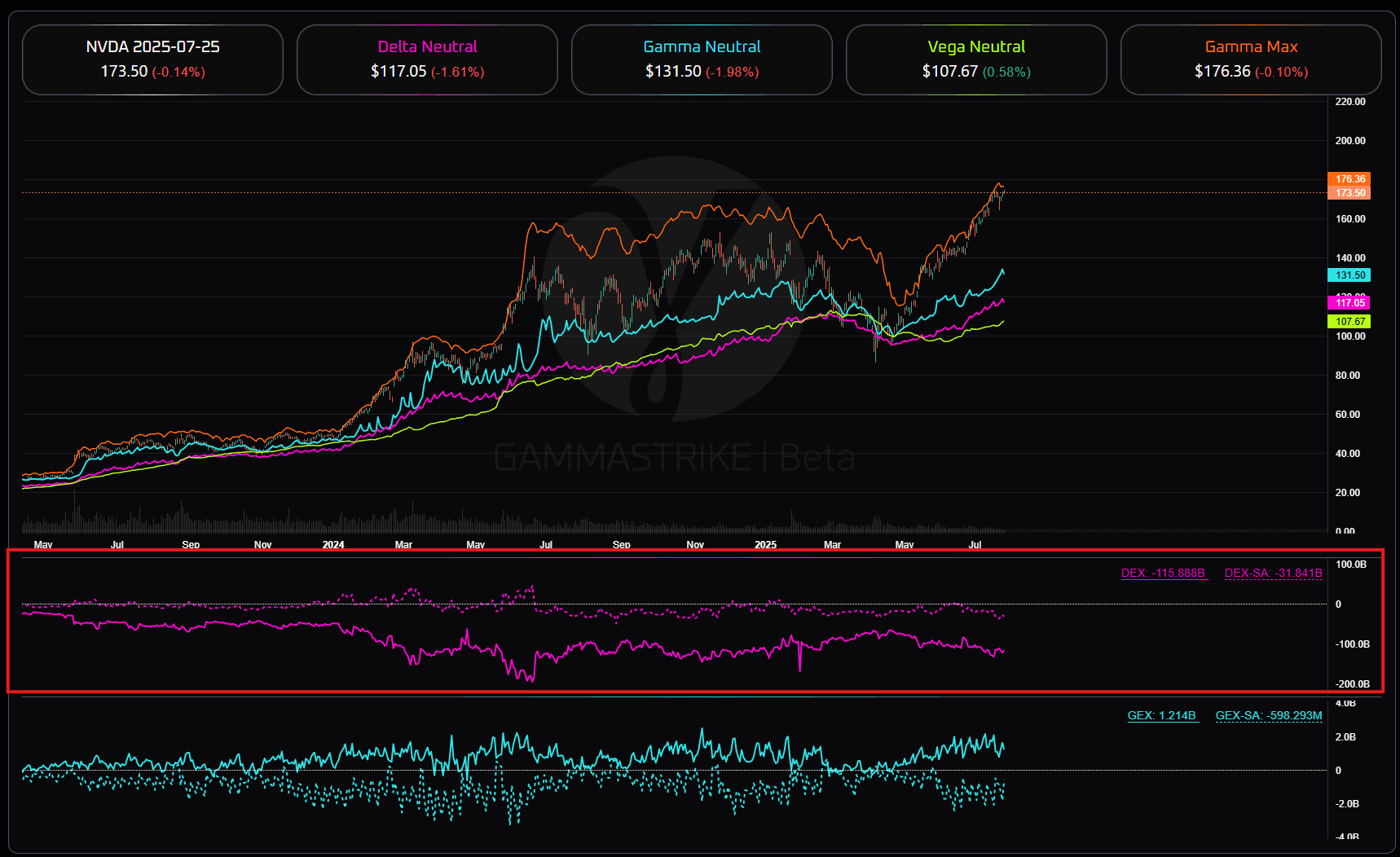
The DEX chart shows estimates of total delta exposure on the chain based on the underlying spot price at the end of each day. Delta Exposure (DEX) is calculated using naive assumptions for puts (bought) and calls (sold), which would require the market makers to hedge all options by selling the underlying. Because of this assumption, the DEX value is always negative, and represents the maximum amount of possible value devoted to delta hedging. Increasingly negative numbers imply that options interest on a stock is growing over time. Perhaps counterintuitively, this increasingly negative number is generally bullish, as typically an increase in options interest almost always coincides with an increase in long term positive speculation on the underlying. A common rule in markets: more eyeballs, higher price. The reason the delta is negative stems from the naïve assumption, which is sometimes valid for Indexes and rarely valid for individual stocks. Despite the invalidity, it still provides some important information about market participant behavior.
Skew Adjusted Delta Exposure (DEX-SA) algorithmically incorporates the implied volatility (IV) of each option to create a relative measure of how bought or sold each contract is, to gauge how bullish or bearish market participants are on the underlying. This is complementary to the naïve DEX. If naïve DEX assumes maximum bearishness, then the DEX-SA provides a relative measure of how incorrect that assumption is. When DEX-SA increases relative to DEX, this signals an increase in bullishness from market participants, and vise versa. Interestingly DEX-SA tends to be mean reverting, as volatility itself is naturally mean reverting. Thus, very bullish levels and very bearish levels tend to be consistent indicators that a revert to mean is on the horizon.
3.2.1.8 Gamma Exposure
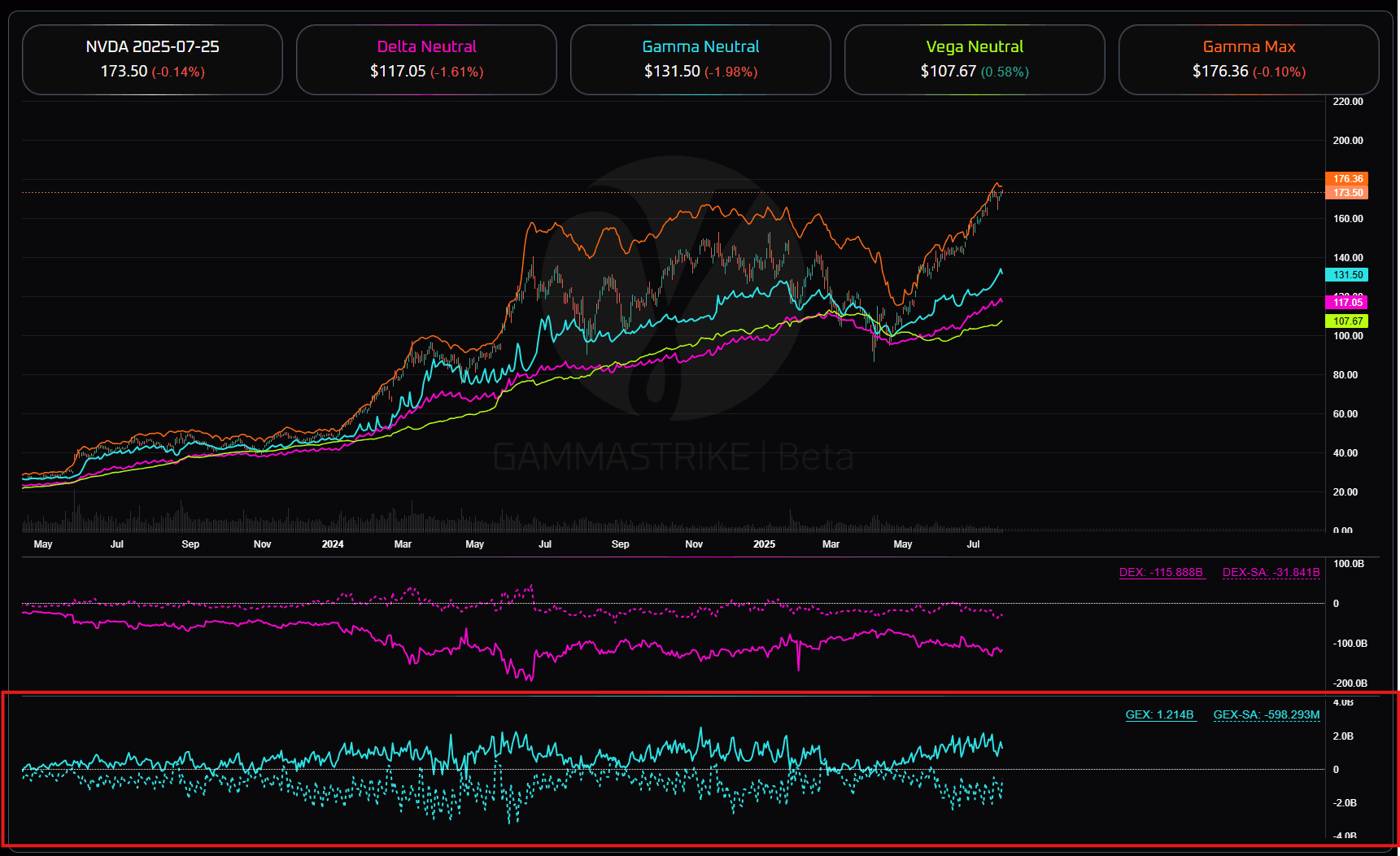
The GEX chart shows estimates of total gamma exposure on the chain based on the underlying spot price at the end of each day. Gamma Exposure (GEX) is calculated using naive assumptions for puts and calls. Under these conditions, positive (negative) gamma indicates that market makers are trading against (with) price action, which tends to reduce (increase) volatility. Skew Adjusted Gamma Exposure (GEX-SA) algorithmically incorporates the implied volatility (IV) of each option to create a relative measure of how bought or sold each contract is, to gauge how bullish or bearish market participants are on the underlying. Thus, strong deviation of GEX-SA from GEX can indicate that the naive assumption has lower accuracy, and that puts may be sold and/or calls may be bought.
3.2.1.9 Update Schedule
The data updates twice daily: once after 7:00 PM EST and subsequently a few hours before market open, based on the timing of OCC open interest reporting.